📚 Product Documentation
InventoryMod Documentation
A complete, plain-English guide to everything inside InventoryMod — the free warehouse & inventory management app. Learn how to manage products, run stock movements, reserve items for orders, receive purchases, reconcile physical counts, and export your data. Every feature below works identically on the Web App, the Chrome Extension, and the Android App, because all three share the same engine and database structure.
1. Getting Started
InventoryMod needs no sign-up, no credit card, and no server setup. Choose the platform that suits you:
The left-hand menu (or the bottom navigation bar on mobile) groups every screen into four areas: Catalog (products, customers, suppliers), Operations (stock, orders, purchases, reservations), Control (movements, reconciliation, reports), and System (import/export, settings). A typical first run looks like this:
- Create a warehouse (or use the default one).
- Add products manually or import a catalog from Excel/CSV.
- Post a Stock In to set your starting quantities — or import balances.
- Start tracking: create orders, receive purchases, and watch the dashboard.
2. Dashboard & Analytics
The Dashboard is your home screen. It summarises the health of your inventory at a glance so you know what needs attention today.
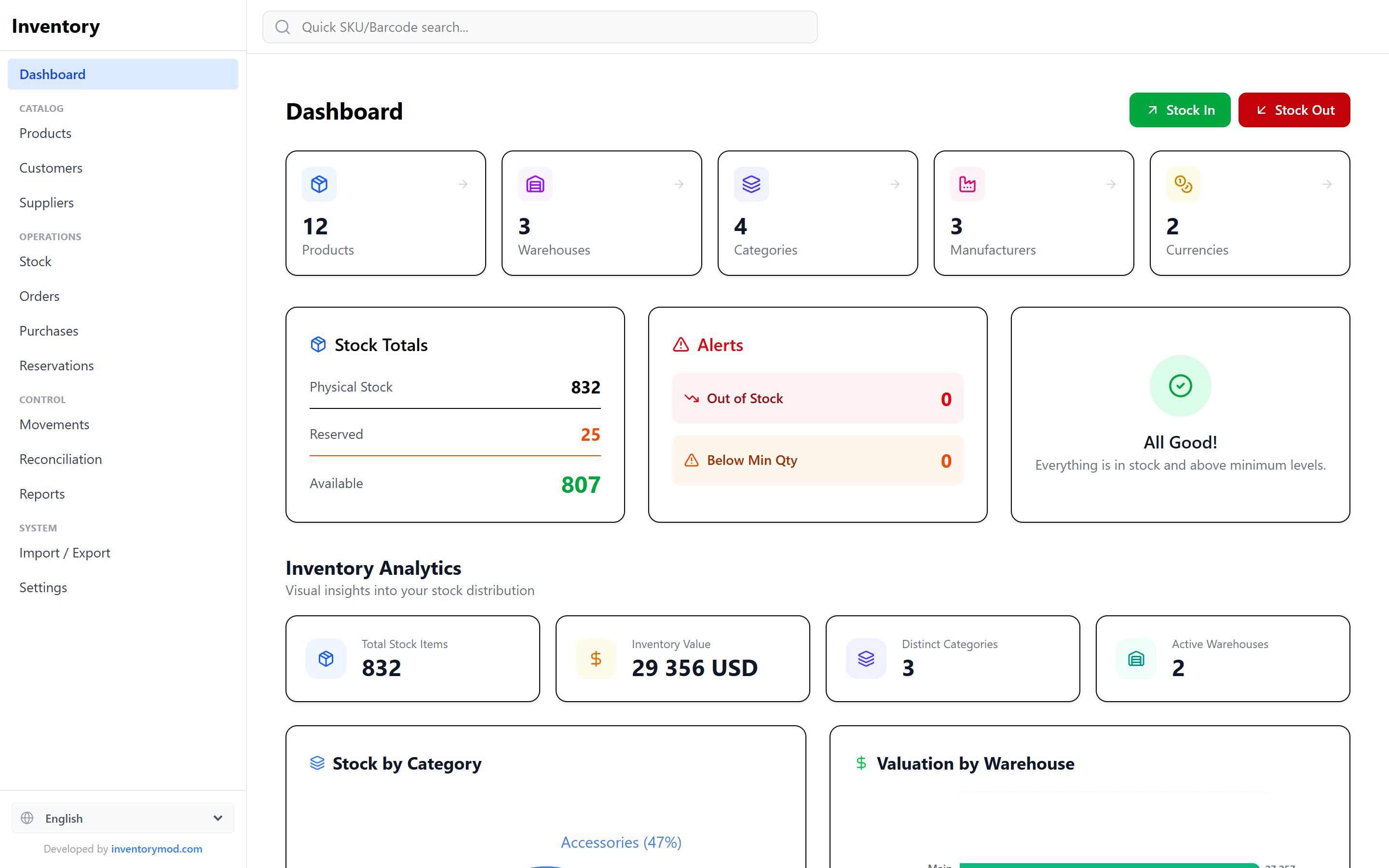
- Stock totals & physical stock — the total number of units across all warehouses.
- Stock In / Stock Out — recent inbound and outbound volume.
- Alerts — items that are Out of Stock or Below Minimum Quantity. When everything is healthy you'll see an "All Good!" state; otherwise a "Stock Review Needed" card links you straight to the Stock page.
- Recent Movements & Reservations — the latest activity, with a "View All" link.
The Inventory Analytics block gives visual insight into how stock is distributed: total stock items, total Inventory Value, distinct categories, active warehouses, plus charts for Stock by Category and Valuation by Warehouse.
3. Products & Catalog
The Products page is the master catalog of everything you sell or store. Each product supports a rich set of fields:
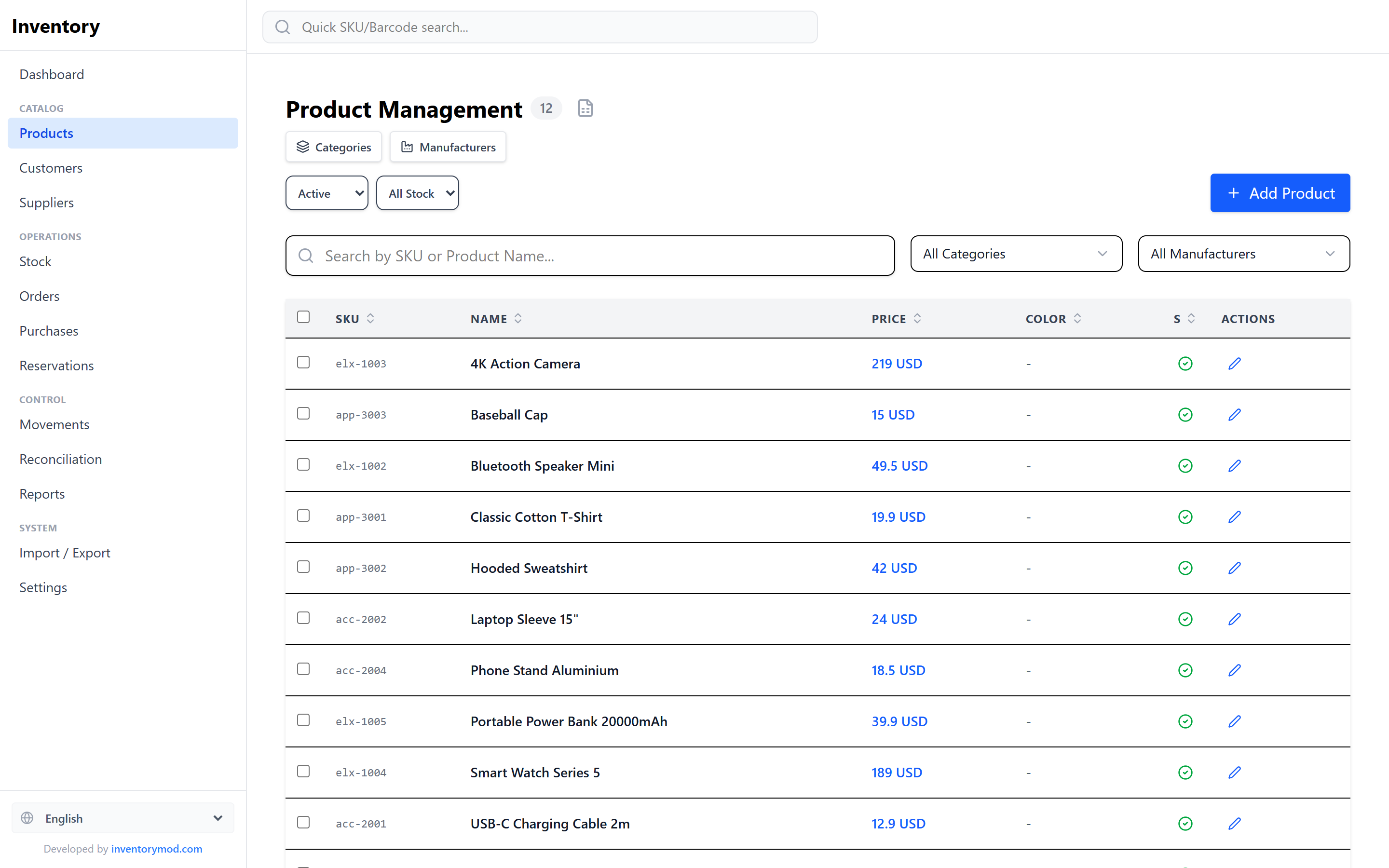
SKU, Name, Barcode, Category, Manufacturer, Price & Currency, RRP (recommended retail price), Purchase cost & purchase currency, Minimum quantity (for low-stock alerts), Product URL, Image URL, and unlimited Custom Fields (text, number, or date) that you define in Settings.
What you can do on the Products page:
- Search & filter by SKU or name, by category, by manufacturer, by status (Active / Archived), and by stock state (In Stock / Low / Out).
- Add, edit, or duplicate a product — duplicating is handy for creating variants.
- Price History — every price change is recorded with a date, so you can see how a product's price evolved.
- Bulk actions — select multiple products to bulk archive, bulk restore, or bulk-update their category/manufacturer at once.
- Export selected products or the whole catalog to CSV or XLSX.
- Archive vs. delete — archiving hides a product while keeping all its history intact (recommended). Permanent deletion is only offered when it's safe, and clearly warns you when related stock, movements, or orders would also be removed.
4. Categories & Manufacturers
Organise your catalog with two reference directories:
- Categories — support unlimited nesting. A category can have a parent, letting you build a tree (e.g. Electronics → Phones → Accessories). You can add subcategories and expand/collapse the whole tree.
- Manufacturers / Brands — a simple directory you assign to products for filtering and reporting.
Both are reachable directly from the Products page, and both can be imported.
5. Warehouses
Manage as many storage locations as you need — physical warehouses, shops, vans, or virtual locations. Each warehouse has a name, code, address, optional capacity limit, and contact info. One warehouse is marked as the Default.
There are two warehouse types:
Your own warehouse with normal stock-in / stock-out operations.
A supplier availability showcase. Imports run as a snapshot: they set absolute quantities and zero out items missing from the feed — perfect for syncing a dropship supplier's stock with no manual clean-up.
Set a capacity to monitor how full a warehouse is; the Stock page shows load and "Critical Load" warnings.
6. Stock Management
The Stock page shows a live balance for every product in every warehouse, split into Physical Qty (what's on the shelf) and Available (physical minus what's reserved for orders). Filter by warehouse or by state (In Stock, Low Stock, Out of Stock) and search by SKU or name.
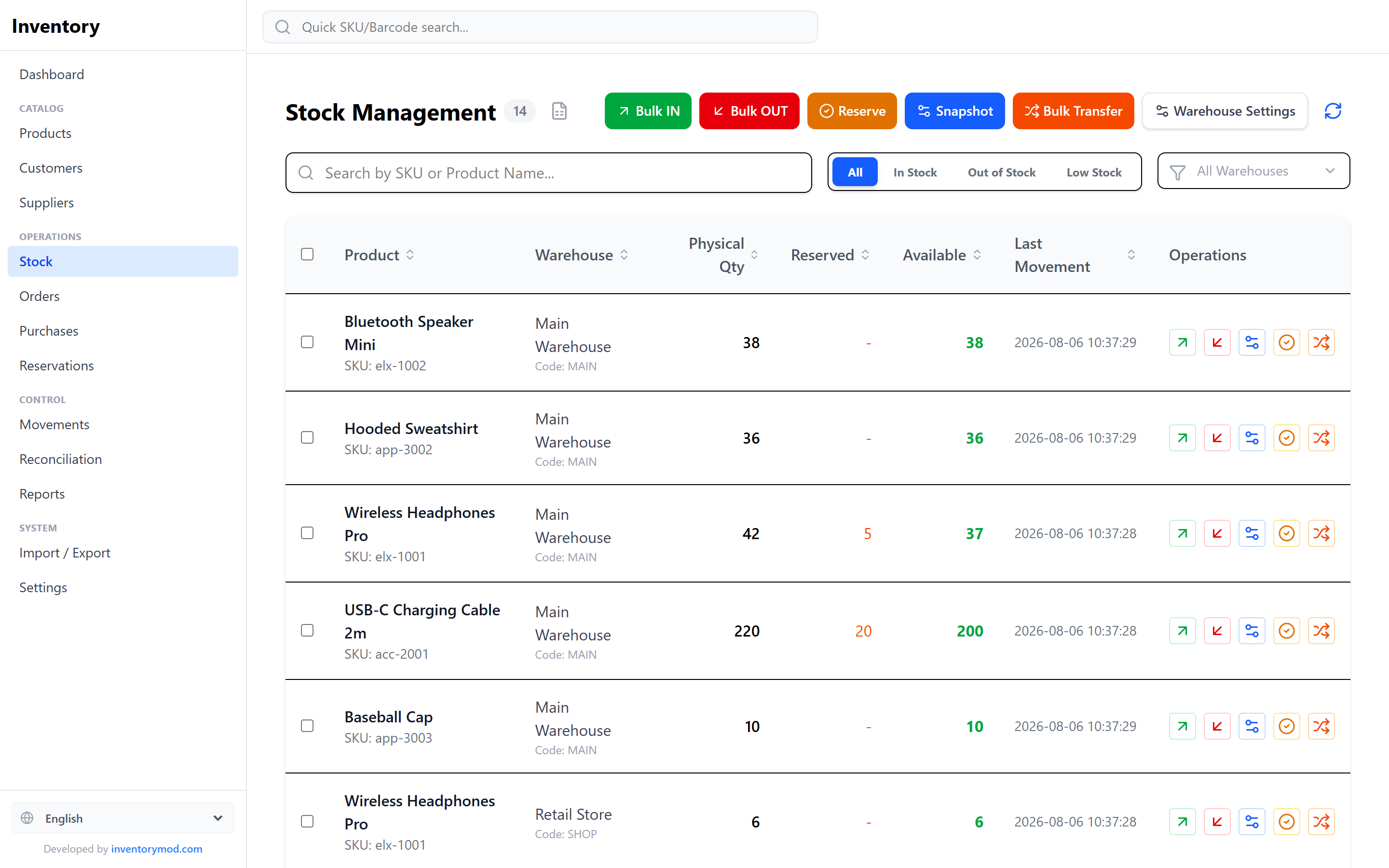
From here you post the core stock operations, individually or in bulk (you can even paste rows from Excel — SKU, Qty, Warehouse, Comment):
Add units to a warehouse. Optionally record a purchase price and currency.
Remove units — e.g. a sale or usage that isn't tied to an order.
Set the exact physical quantity. The app calculates the +/− difference for you.
Move units from a source warehouse to a target warehouse in one step.
Hold stock for an order so it can't be sold twice.
Select several lines to run mass actions: adjust selected, reserve selected, or set quantity to zero. You can also export the current stock view and open Warehouse Settings straight from the toolbar. Whether stock can go negative is controlled by a policy in Settings (see below).
7. Stock Movements
Every change to stock is written to an immutable Movements ledger — your complete audit trail. Each row records the product, warehouse, quantity change (Delta), the resulting balance (After), the document it belongs to, the date/time, and the movement type:
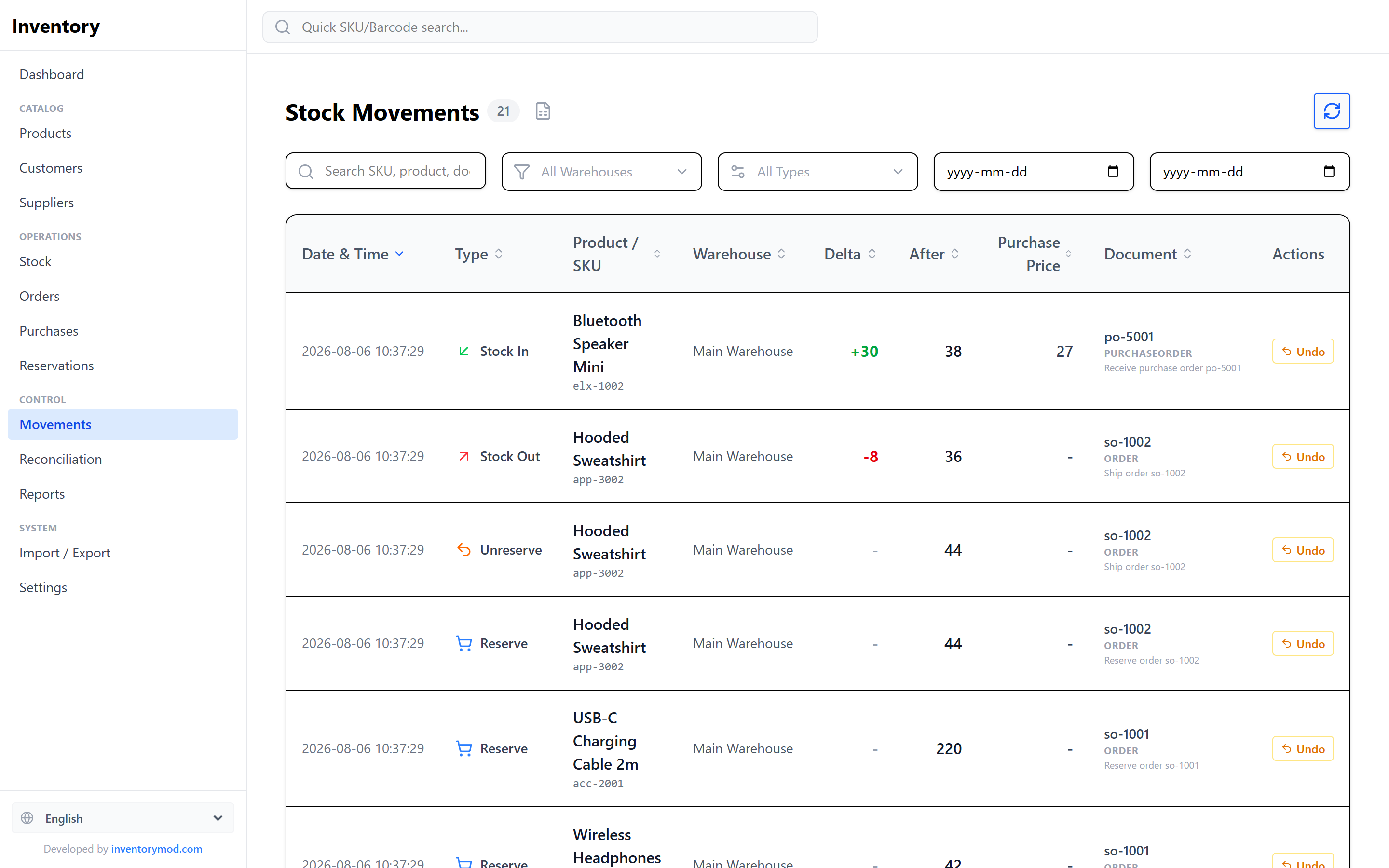
Stock In · Stock Out · Adjustment · Transfer In · Transfer Out · Reserve · Unreserve · Sale From Reservation · Return In · Write Off
Search by SKU, product, or document and filter by type. Made a mistake? A movement can be undone within 15 minutes, which creates a matching reversal entry so history stays accurate.
8. Reservations
Reservations let you set aside stock for a customer before it ships, so the same units are never promised twice. Reserved quantity lowers a product's Available figure while keeping its Physical count unchanged.
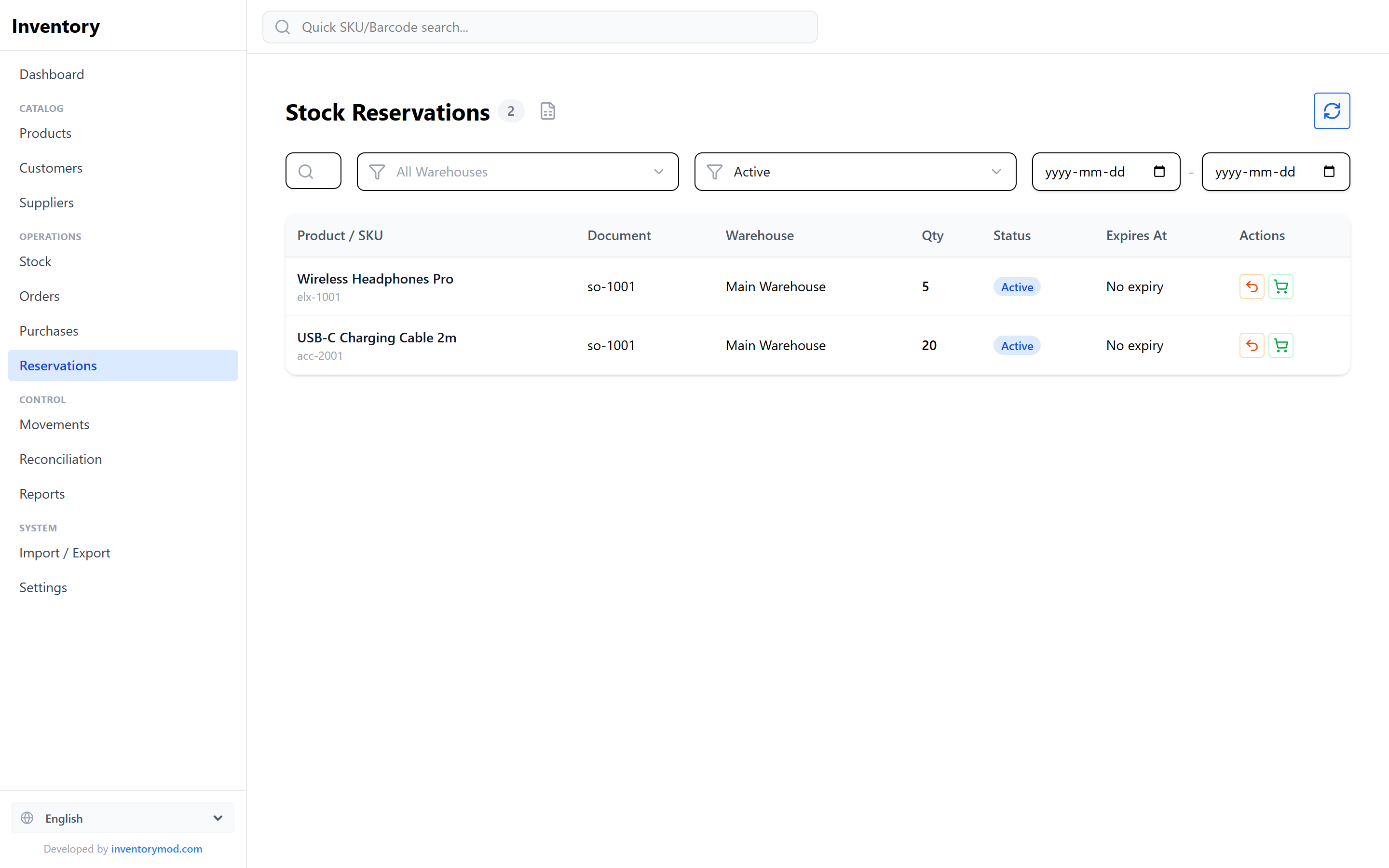
The Reservations page lists every hold with its status — Active, Released, Consumed, or Expired — and an optional expiry date. For an active reservation you can:
- Release — return the units to available stock (e.g. the customer cancelled).
- Consume — deduct the units from physical stock (the goods actually left).
Whether you can reserve more than is physically in stock is governed by the "Allow Over-Reservation" policy in Settings.
9. Customer Orders
Orders capture what your customers buy and drive stock out of your warehouses in a controlled way. Create an order with an order number, an optional customer, a free-text source (Shopify, Phone, B2B…), and one or more line items — each with a product, warehouse, and quantity.
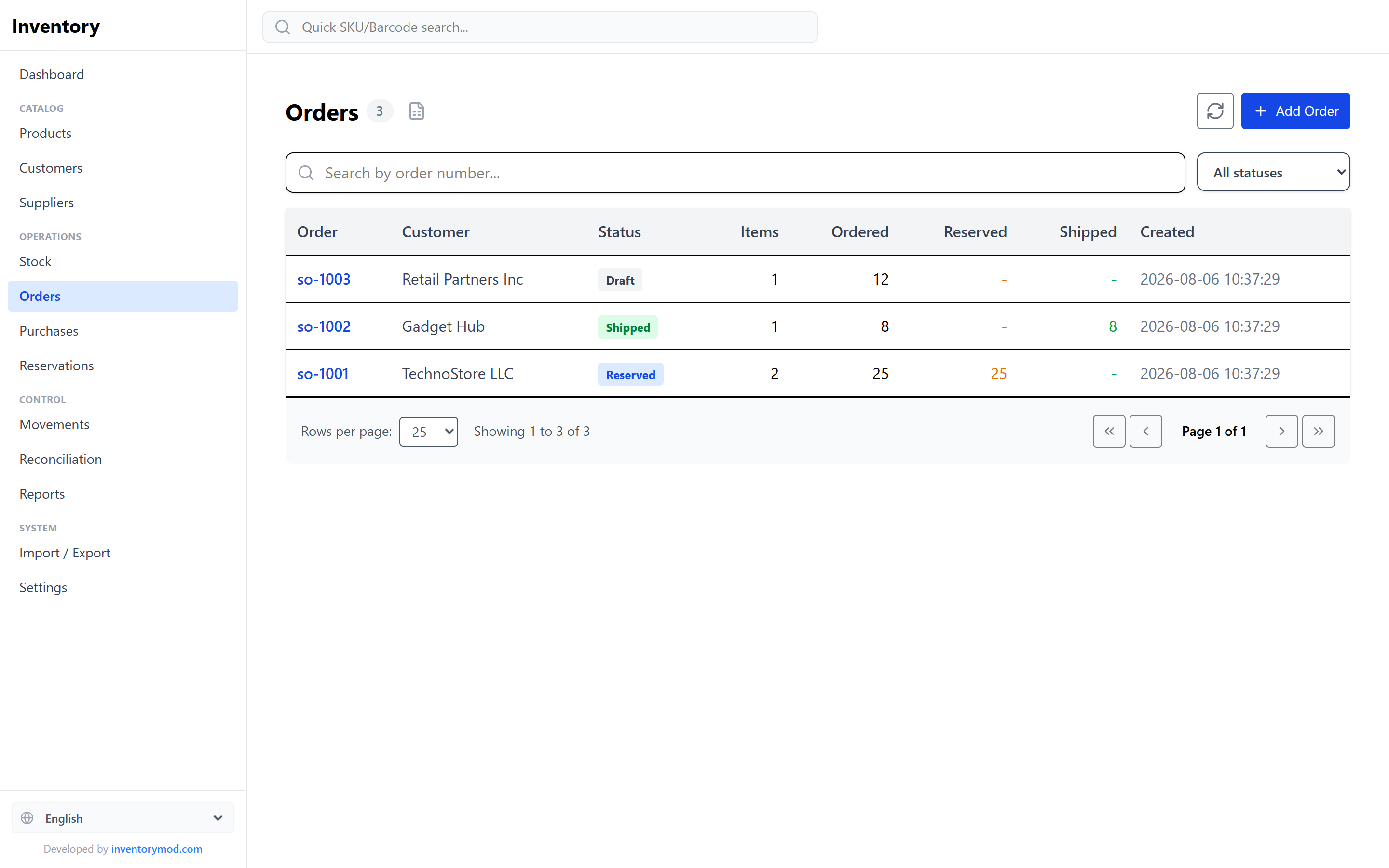
As you build the order, InventoryMod shows live availability per line, warns when you're short, and lists where the product is in stock. An order then flows through clear statuses:
Draft → Partially Reserved → Reserved → Partially Shipped → Shipped (or Cancelled)
- Reserve stock for the order to guarantee availability.
- Ship to convert reservations into an actual stock-out (a "Sale From Reservation" movement).
- Cancel to void the order — any active reservations are automatically released.
Filter orders by status or search by order number.
10. Customers
A directory of the people and businesses you sell to. Each customer stores a name, code, contact person, email, phone, address, and comments, and can be linked to orders. Customers can be archived when no longer active.
11. Suppliers
A matching directory for the vendors you buy from — name, code, contact, email, phone, address, and comments. Suppliers are attached to purchase orders so you always know where goods came from.
12. Purchase Orders & Receiving
Purchase Orders (POs) manage restocking from your suppliers. Create a PO with an order number, an optional supplier, an expected date, and line items — each with a product, quantity, and optional purchase price & currency.
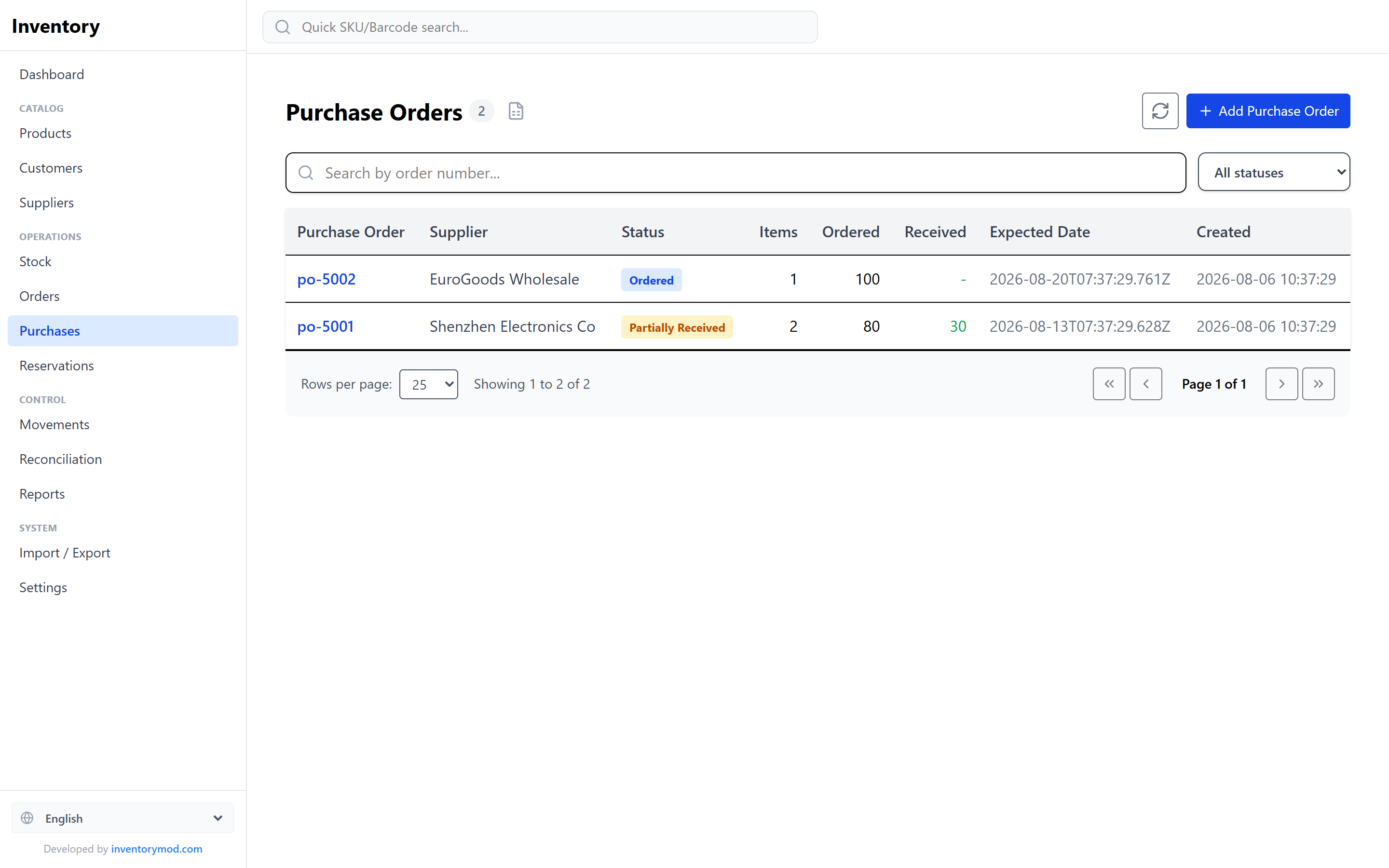
A PO moves through its own lifecycle:
Draft → Ordered → Partially Received → Received (or Cancelled)
When goods arrive, use Receive: pick a target warehouse and enter the quantity received per line (you can receive partially, and the "Remaining" column tracks what's still outstanding). Receiving automatically creates the corresponding Stock In movements — no double entry. The Reports page shows overall receiving progress.
13. Currencies
Work in multiple currencies. Define each currency with a name and an exchange rate relative to your default currency (the default always has a rate of 1). Prices and purchase costs can be stored in any defined currency, and valuations on the dashboard and reports use these rates to convert everything to your base currency.
14. Stock Reconciliation
Reconciliation makes a physical stock-take painless. Upload a CSV of your counted quantities with three columns — SKU, Qty, and Warehouse — and InventoryMod matches each row to your records and shows the difference between the counted quantity and the current system quantity.
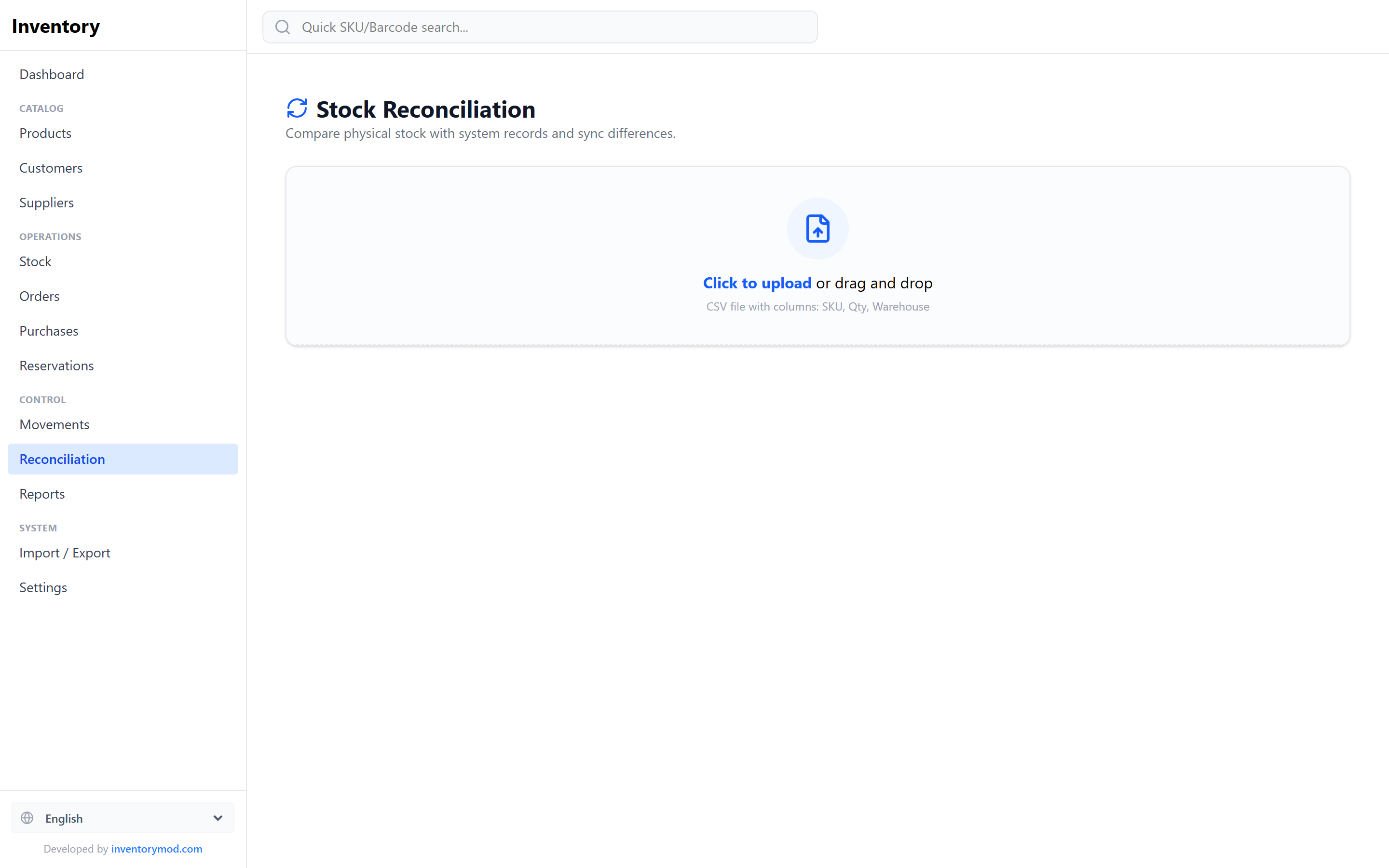
Review the differences, then sync to apply them as adjustments in one click. Rows that can't be matched (unknown SKU or warehouse) are flagged so you can fix them first. It's the fastest way to bring the system in line with reality after a count.
15. Reports
Reports turn your movement history into money. Based on recorded purchase costs and sale prices, the Reports page shows:
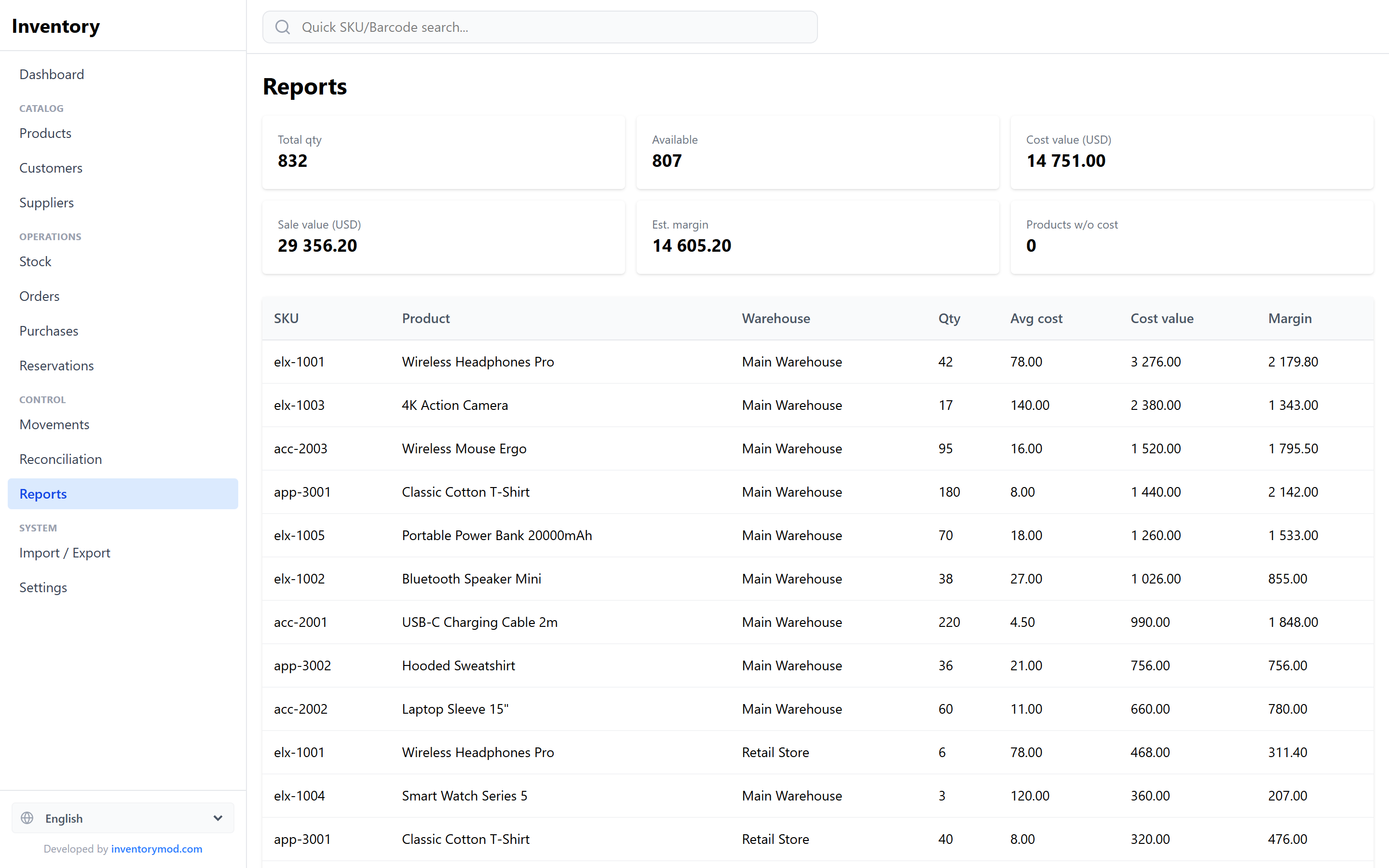
- Cost Report — stock cost value, sale value, and estimated margin, using either average cost or last cost. Items without a recorded purchase cost are listed separately so you can fill the gaps.
- Purchase Summary — an overview of purchase orders and their receiving progress.
16. Import / Export
Almost every entity can be imported and exported — products, categories, manufacturers, currencies, customers, suppliers, warehouses, and stock balances. Export any of them to CSV or Excel (XLSX) at any time.
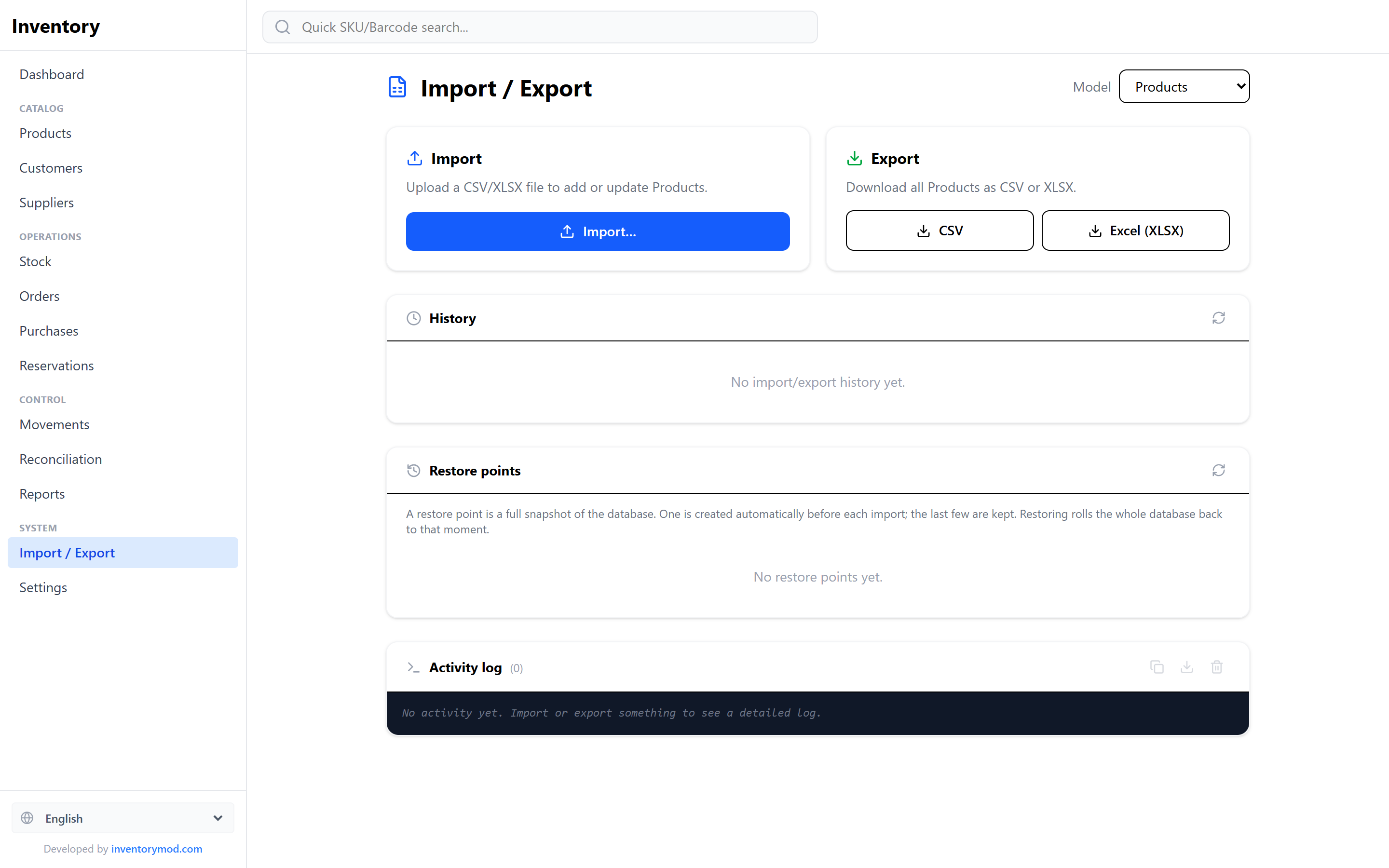
The guided Import Wizard handles messy real-world files:
- Three input sources — upload a file, paste a table (straight from Excel), or load from a URL. Encoding and delimiter are auto-detected, and downloadable templates are provided.
- Smart column mapping — columns are auto-matched to fields, and you can save reusable mapping profiles for feeds you import regularly.
- Import modes — Create only, Update only, or Create & Update, matching records by SKU (or another key). Missing categories, brands, and currencies can be created automatically by name.
- Stock imports — choose the operation (Stock In, Stock Out, or Snapshot) and a target warehouse. Supplier warehouses are locked to Snapshot for clean feed syncing.
- Dry-run & validation — a preview checks references, counts ready / error / duplicate rows, and lets you download the skipped rows so nothing silently fails.
- Undo — an import can be reversed, deleting the records it created, and a full activity log records every batch.
17. Settings & Backup
Settings is where you tailor InventoryMod's behaviour and safeguard your data.
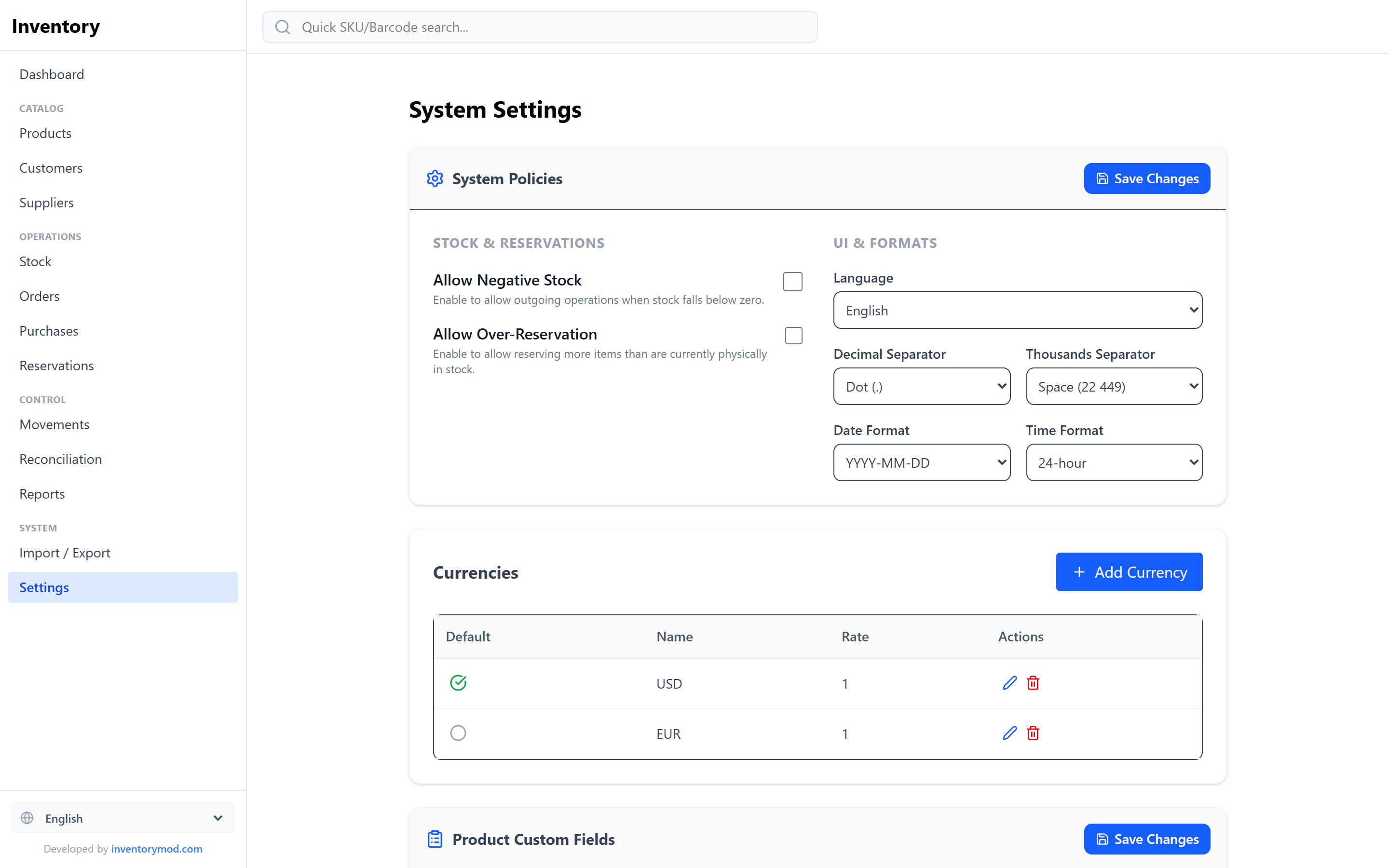
- System policies — Allow Negative Stock (permit outgoing operations when stock would drop below zero) and Allow Over-Reservation (reserve more than is physically in stock).
- UI & formats — language, decimal separator, thousands separator, date format, and 12/24-hour time.
- Product custom fields — define extra fields (text, number, or date) that then appear on every product, e.g. Color or Expiry.
- Mobile bottom navigation — choose which sections get quick-access buttons on phones.
- Backup & restore — export your entire database to a single JSON file, and restore it later to replace the current data.
- Restore points — full database snapshots. One is created automatically before every import, and you can create them manually; restoring rolls everything back to that moment.
- Maintenance — clean up orphaned stock rows that reference deleted products.
- Danger zone — permanently wipe all data to start fresh (settings are kept). This is irreversible, so export a backup first.
18. Frequently Asked Questions
Is InventoryMod really free?
Yes. All three versions — Web, Chrome Extension, and Android — are free to use, with no credit card and no sign-up required to get started.
Are the Web, Chrome, and Android versions different?
No — they share the same engine and identical features. The Chrome Extension and Android app store data locally on your device, while the Web App is ideal for teams and multi-device access.
Where is my data stored?
In the offline versions, your data is stored locally in a SQLite database on your device — nothing is sent to a server. Use the built-in backup and restore points to keep it safe.
Can I import my existing product list?
Yes. Use the Import Wizard to upload a CSV or Excel file (or paste from Excel). It auto-maps columns, validates rows, and can create missing categories and brands automatically.
What's the difference between physical and available stock?
Physical stock is what's actually on the shelf. Available stock is physical minus the quantity reserved for orders — so you never promise the same units to two customers.
Can I undo a mistake?
Yes. Stock movements can be undone within 15 minutes, imports can be reversed entirely, and you can roll the whole database back to any restore point.
Ready to organise your inventory?
Start free in seconds — no sign-up, no credit card.